

I've invested in real estate for years. I believe rental properties can be an excellent way to build wealth. But there's a question investors don't ask often enough: If I had my equity in cash today, would I buy this same property again?
I'm asking myself that question about one of our rentals right now.
How to Calculate Your Rental Cash Flow
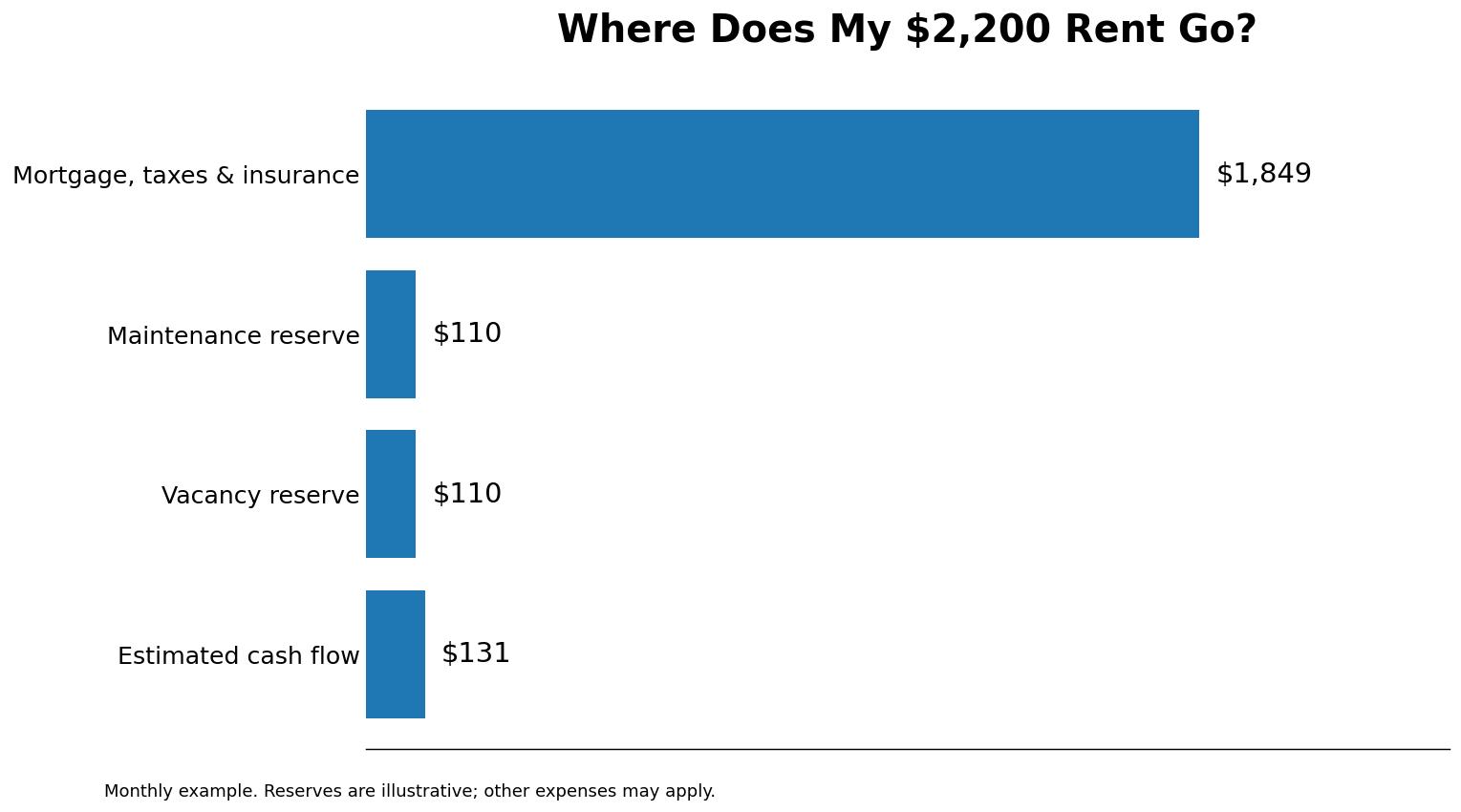
Monthly rent − mortgage, taxes, insurance, maintenance, vacancy reserve and other expenses = estimated monthly cash flow.
Here's a real example from one of our rentals:
| Monthly item | Amount |
|---|---|
| Rent | $2,200 |
| Mortgage, taxes and insurance | −$1,849 |
| Money left before reserves | $351 |
| Example maintenance reserve (5% of rent) | −$110 |
| Example vacancy reserve (5% of rent) | −$110 |
| Estimated monthly cash flow after example reserves | $131 |
That's approximately $1,572 a year, before any other costs. The reserves are examples, not a one-size-fits-all rule. Older properties and properties with upcoming repairs may need more.
The rental that made me reconsider
We bought it for approximately $355,000, putting 25% down and financing the rest at 6.875%. Today it rents for about $2,200 a month. After mortgage, taxes and insurance, we clear around $351 a month, or $4,212 a year. That's before vacancy, ongoing maintenance, and reserves.
Last year we spent approximately $20,000 addressing drainage and crawl space problems. Now the HVAC needs replacing, with a quote around $9,800. That's nearly $30,000 in major expenses. At $4,212 a year, it represents about seven years of today's money left after monthly bills. Those repairs aren't necessarily wasted money, but they change the investment picture.
Look at what your equity could do elsewhere
We think the property might list around $389,000, although a list price isn't a sale price. With a mortgage balance near $266,000, that's roughly $123,000 of gross equity. After illustrative 6% selling costs, we'd have about $99,660 before taxes, concessions, repairs and other adjustments.
That's approximately a 4.2% annual cash yield on the equity we might recover, based on the current $4,212 annual money left after monthly bills. It's not the whole return. Appreciation, principal paydown, and taxes matter too. But it's a useful reality check.
We also have a home equity loan at approximately 8.8%. Putting $75,000 toward that debt could avoid roughly $6,600 in first-year interest at an unchanged rate, before considering repayment period. That compares favorably with the rental's current money left after monthly bills and doesn't involve tenant calls or surprise repairs. Paying down a loan, however, doesn't necessarily lower its required monthly payment automatically.
The tax piece matters
A small difference between the purchase and sale prices does not necessarily mean no taxable gain. Some improvements can increase tax basis; routine repairs may not. Depreciation reduces adjusted basis and can create taxable gain on sale. I would review the actual numbers with my tax professional before making the decision.
When I would keep it
A rental with a strong cash cushion, manageable repair outlook, good financing, and promising rent growth may be worth holding. One bad repair year alone isn't a reason to sell. I compare realistic hold projections with net sale proceeds, tax consequences, and the next-best use of the money.
The lesson: Being a real estate investor doesn't mean you have to hold every property forever. Sometimes selling is the disciplined investment decision.
If you're evaluating a rental in Fredericksburg, Stafford County, or Northern Virginia, I can help you explore financing options and run the mortgage side of the numbers. No hype, just a clear picture of the choices.
Common Questions
Is $350 a month good rental income? It depends on repairs, vacancy, and how much money is tied up in the home.
Should I sell after one big repair? Not always. Compare future costs and the money you could get from a sale.