

What if one of the most valuable features of a house is the mortgage already attached to it?
Certain FHA and VA mortgages can be assumed by a qualified buyer, subject to program rules and the existing company handling the mortgage's approval. Instead of taking a new mortgage at current pricing, the buyer takes over the existing loan's balance, interest rate and remaining term. That can be a real opportunity, but only if the whole transaction works.
Start with the difference between the price and the seller’s mortgage balance
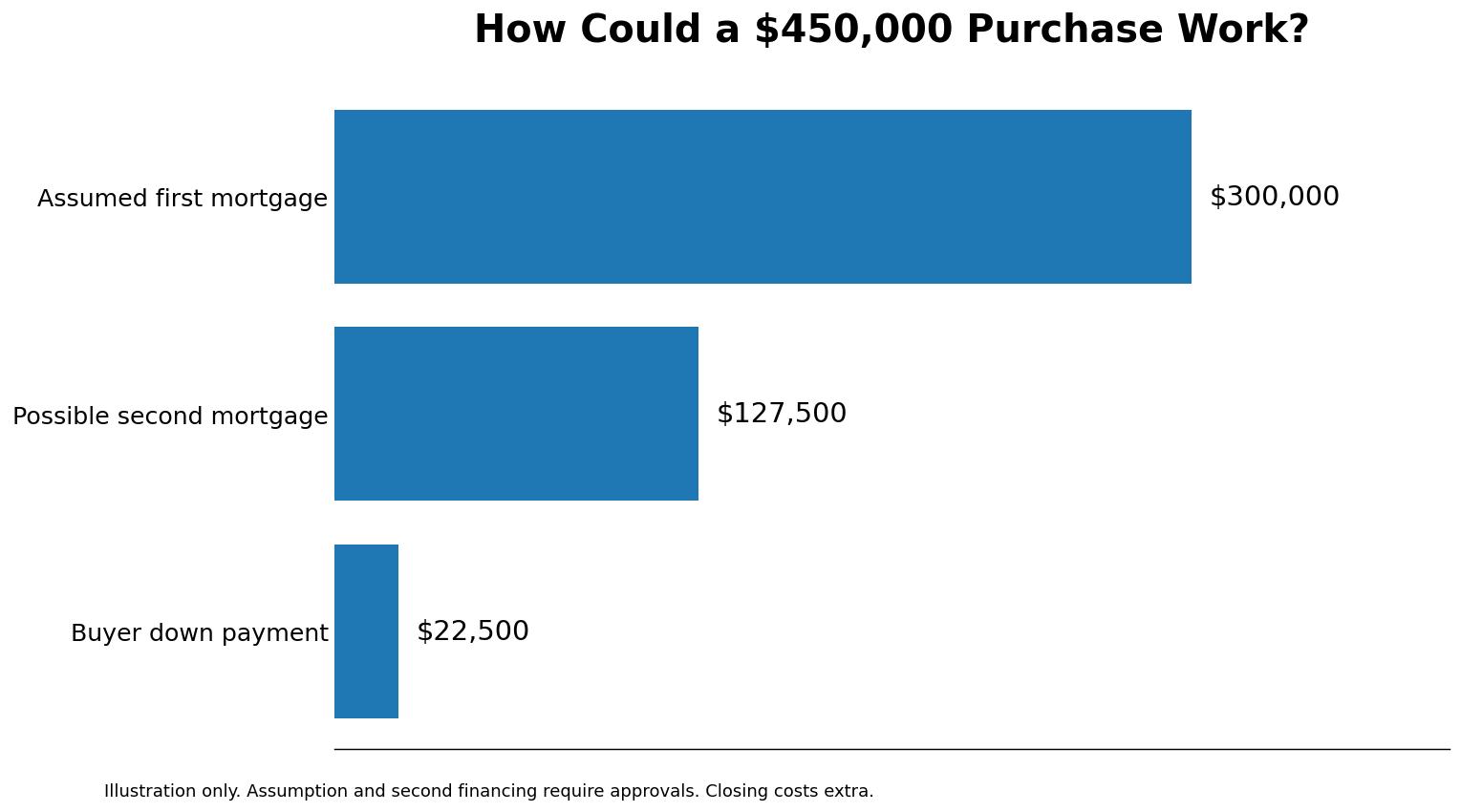
Imagine a $450,000 home with an assumable $300,000 mortgage at 3%. The buyer doesn't get a $450,000 loan at 3%. The buyer assumes $300,000 and must cover the other $150,000 plus closing costs.
If that first mortgage has 25 years left, the loan payment before taxes and insurance on $300,000 at 3% is approximately $1,423 monthly. That's attractive, but the cash needed to bridge the difference between the price and the seller’s mortgage balance can be a dealbreaker.
Can You Finance the Difference Instead of Paying Cash?
We're exploring a partner financing option that may permit up to 95% total amount borrowed compared with the home’s value for eligible FHA and VA assumption transactions, subject to underwriting, company handling the mortgage approval and program restrictions. On this hypothetical $450,000 purchase, 95% total loan amount compared with the home value means $427,500 in total mortgage debt. After the $300,000 assumed first mortgage, a possible second mortgage would be $127,500. The buyer would still need $22,500 toward the price, plus closing costs and other required funds.
The exact second-lien rate, whether fixed or variable, term, possible balloon, fees, and eligibility must be confirmed. Don't treat 95% total loan amount compared with the home value as guaranteed financing.
The Step You Cannot Skip: Approval From the Current Mortgage Servicer
The existing loan servicer must approve the buyer's assumption, and proposed second financing must meet applicable loan-program and servicer requirements. A second mortgage lender must approve its own loan as well. The existing first mortgage must keep its required lien position. Confirm the arrangement before advertising it as available.
Allow at least 60 days when possible, and confirm the servicer's processing timeline before writing a closing date. Some assumptions take longer.
The blended payment is what matters
Suppose, purely for illustration, the $127,500 second mortgage carried 10% interest over 20 years. Its the loan payment before taxes and insurance would be about $1,230 a month. Added to the assumed first payment of about $1,423, that's roughly $2,653 before taxes, insurance and other costs.
Compare a hypothetical new $427,500 mortgage at 7% over 30 years: the loan payment before taxes and insurance would be around $2,844. The assumption could still help, but the savings are much smaller than the 3% headline might imply. Actual pricing, mortgage insurance, fees, terms and qualification can change the outcome.
Why Sellers Should Care
One thing I hear from homeowners all the time is, “I don't want to give up my 3% mortgage!” And I get it. But what if that low interest rate could actually help you sell your home?
An eligible low-rate loan may help a listing stand out, though it doesn't guarantee a faster sale or higher price.
Why sellers should care
An eligible low-rate loan may help distinguish a listing, attract additional buyers and create a meaningful marketing advantage. But the seller must verify assumption eligibility, current balance, timeline, and release-of-liability procedures. VA sellers also need to understand that release from liability and restoration of VA entitlement are separate issues. An assumption by a nonveteran buyer generally does not restore the seller's VA entitlement.
Why buyers should care
Ask for the current loan balance, rate, remaining term, full escrow payment, assumption fees, cash-to-close estimate, second-lien terms, and the company handling the mortgage's expected process. Compare the total financing cost with a new mortgage. Assumptions can take longer than a typical purchase loan, and approval is not automatic.
Listing Agents: Six Steps Before Advertising an Assumption
- Identify the mortgage. Ask the seller whether it's FHA, VA, or another assumable loan, and get a current statement.
- Have the seller call the servicer. Confirm assumption eligibility, process, fees, timing, liability release, and whether second mortgages are permitted. Ask the maximum total financing allowed, including whether a 95% combined structure could qualify.
- Calculate the equity gap. Estimated sale price minus existing mortgage balance equals the amount the buyer must cover.
- Talk to an assumption-savvy lender. Check whether a proposed second mortgage meets the first servicer's and second lender's requirements.
- Market carefully. Describe the loan as potentially assumable by a qualified buyer subject to servicer approval. Don't promise payments or approval.
- Build a realistic timeline. Coordinate the assumption servicer, second lender, title team, and both agents.
VA sellers: Release of liability and restoration of VA entitlement are separate questions. Confirm both.
The Realtor strategy
Listing agents should identify assumable loans before marketing, confirm details with the seller and company handling the mortgage, and avoid promising a guaranteed payment. Buyer's agents should compare financing alternatives early and structure contract deadlines around realistic assumption processing times. Both sides benefit from a lender who understands the math and communicates clearly.
Sometimes the answer is no
If the seller's equity is too large, the second mortgage too expensive, or the timing too uncertain, the assumption may not make sense. A low rate is a tool, not a reason to ignore the numbers.
If you're buying or selling in Fredericksburg, Stafford County, or Northern Virginia, send me the property address, approximate mortgage balance and rate. We'll explore whether an assumption is worth pursuing.
Common Questions
Can a nonveteran assume a VA loan? Sometimes, yes. But the seller’s VA benefits may remain tied to the loan.
Do I need a big down payment? Maybe. It depends on the seller’s loan balance and whether you qualify for other financing.